
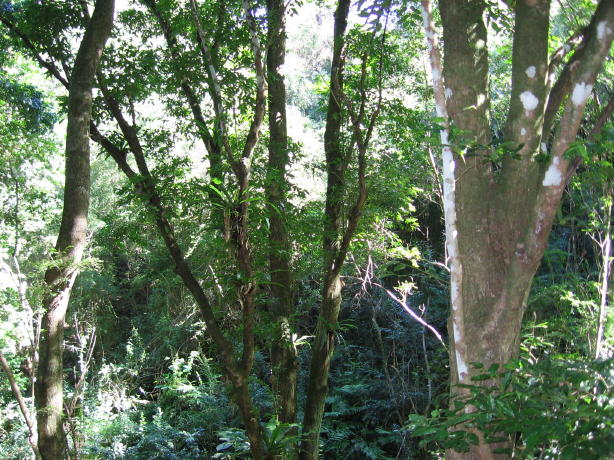
These some of the things I've been doing
and some of the things I will be doing over the next while.
You'll find some opinions in here as well.
- Revegetation
- Plant List
- Fire sticks and the passing of time.
- Erosion, deposition and rain.
- Putting some figs back.
- The Shade House
I try to grow local plants. To be more technical, propagate local provenances, which is slightly different.
For instance, we could buy Red Cedars (which we know grew in abundance in the valley) from local nurseries and perhaps wind up with plants sourced from Tinonee or Dingo Creek catchments, they are local plants and they would be local plants too if they came from Kangaroo Valley on the South Coast of NSW, hundreds of kilometres away. On the other hand, to propagate a plant of local provenance would mean to propagate from stock you know to be truly local. In the case of wind blown seed like Red Cedar can be that could mean within the same valley system. Black Booyong is a good case in point, their seeds are heavey and helicopter down from the canopy and would be really lucky to land more than 100 metres from the parent tree on a stormy day. Of course it can also depend on how far your pollen travels to cross polinate between flowers, does the plant use birds, bees, other insects, weevils or wind. Basically it is generally good to use local provenances when you can, they have adapted or been selected over the millenia to the local conditions, be they human induced fire regimes (over 40 millenia or 200 years, take your pick for intensity or frequency), soil types, rainfall etc, they are likely to grow better and if you need to and can propagate, they are cheaper than buying in plants.
The trees here were big before the land was cleared. There is at least one photo of the valley with houses that still stand today from the late 1920s, one of the houses is still surrounded by uncut trees on the hill side, mostly Blue Gum or White Beech, the trunks seem to be whitish, it's a little hard to tell (we know we also had very significant amounts of millable White Beech in our section of the valley up until the late 1920s). The house appears as if it were a match box, I guess it would be possible to scale the trees from the house. They are big, kind of like some of the Moreton Bay Figs in Wingham Brush are big, though a number of the figs a lot smaller now after losing a few limbs after the drought finished. If you can, imagine a whole valley filled with trees on a similar scale. The first European to actually live in the valley lived in a tree until he cut enough timber to build a house, he moved into Mooral Creek during 1903. There was a lot of timber taken out of the valley, there were two small timber mills on the adjoining portions alone
I digress, basically what I'm getting at is that replacement and spread of any variation inside the provenances of a species could be exceptionally slow, especially for those species that do not produce fruit that are spread by Bats, Pigeons, Dollar Birds, Brush Turkeys and the like. This could be more so from one valley system to the next. I was lucky enough to find a local up the valley who still had some Red Cedar who was selling seedlings for a timber lot.
So generally I source my seed or cuttings from our valley, all of our neighbours are very generous in this respect but they are anyway. Of course there are some species that I want to put back that I can't find to propagate, then I will buy them. One recent example is Sloanea woolsei, the Yellow Carrabeen. I know it grows in the area in National Parks but I've never seen one around the place.
How do I know they probably used to grow here If I can't find them? There have been a few major works undertaken by researchers, most notably Alex Floyd, to group rainforest species and rainforest types, resulting in what are called alliances and sub alliances.
Generally if you find 2 or 3 species mentioned in an alliance or sub alliance you can be moderately certain that others were probably there, you just haven't found them yet, so keep looking. That's the difficult bit, you have to know what you are looking for, what it looks like. Using identification keys is okay if you happen to be able to get some leaves, photos are better for id at a distance, where it is obvious what you are looking at. As an example, I never used to believe we had any Black Booyong. After a couple of years and visits to various places like nurseries and Tapin Tops I got an understanding of what to look for. I then found 2 specimens in different locations, still very much adolescent, growing through Waterhousia floribunda in both instances. Both skinny and around 5 to 8 metres tall. I guess after a period of time you become aware that hey, those leaves up there aren't like the others, or anything else I've seen around here, same goes for trunks and especially seedlings and if you're lucky, flowers.
Even with 2 or 3 different sets of keys in different sets of books and lots of photos sometimes I just haven't made the connection, or haven't tried hard enough. On one fairly lengthy mostly south facing hillside we have Sassafras, Doryphora sassafras, I knew these trees were there but hadn't tried to hard to id them. Mostly at a bushy 5-8 metres tall I have no real idea how old the root stocks truly are, most have no dominating trunk, they are copicing, I suspect they are probably quite a few years old. It wasn't till we went back to Canberra one year and revisited the ANBG (I worked in the Plant Records section for a couple of years) and smelled the Sassafras, with the label, that I realised that's what they were, then I did the id properly back home.
We have plenty of damp frosty locations below that hill side that most RF species will struggle with till there is cover. I will be propagating Sassafras to help fill in the frosty areas, along with Acacia melanoxylon (Blackwood) and Acacia maidenii which grow in all but the worst open frost spots.
There is one other Sassafras clump I've found on a North West aspect, a little way up from a creek, that is clearly trying to regenerate from an old coppice system, there may have been one larger trunk some time ago, surface soil is actually quite poor though there is a small line of very nice Blue Gums shielding them. Sadly this particular location dried out for too long and they died but there is now a seedling coming up next to Mooral Creek and there are also substantially larger specimens, 20 metres or so tall, all along the Western side of our largest gully, with seedlings appearing in many locations.
Sassafras seedlings grow in snow in southern Australia and Tasmania. Probably the most interesting place I've seen Sassafras is on the way up Mount Donna Buang, near Warburton which is a pleasant day drive North East of Melbourne.

